
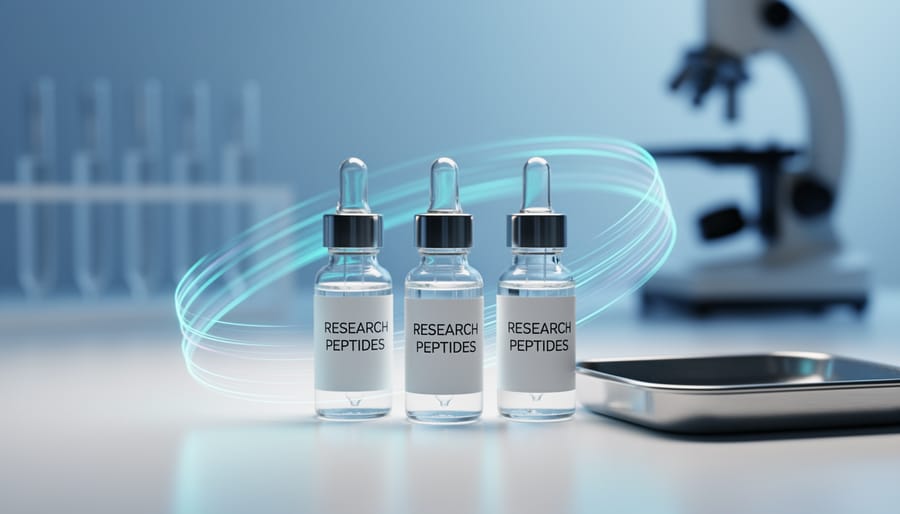
The GLOW blend: BPC-157, GHK-Cu, TB-500 is a research peptide combination that pairs three compounds: GHK-Cu, BPC-157, and TB-500. Each one is a short chain of amino acids studied for its role in tissue repair and recovery. GHK-Cu is a copper-binding peptide found naturally in human plasma, BPC-157 is a synthetic fragment modeled on a protein in stomach fluid, and TB-500 is a synthetic version of a segment of thymosin beta-4. The blend bundles them into one product, which is why the name keeps popping up in wellness circles.
So why the buzz? Mostly because recovery and skin-health talk travels fast at fitness retreats, spa weekends, and wellness expos across Canada, and these three names come up again and again in those conversations. Here’s the catch: most of the research so far comes from lab and animal studies, not large human trials, and these products aren’t approved as medicines in Canada.
Below, we break down what each ingredient is, how they compare, and what the evidence actually says. A handy insider tip if you’re chatting with vendors at a wellness event: ask what’s backed by published research and what’s just buzz.
What the GLOW Blend Actually Means
“GLOW Blend” sounds official, but it isn’t a medical or scientific term. It’s a label some sellers put on a bundle of three peptides: GHK-Cu, BPC-157 and TB-500. Because there’s no standard recipe, one seller’s blend can look quite different from another’s, with different amounts of each ingredient and different ratios.
So what’s a peptide? It’s a short chain of amino acids, the same building blocks that make up proteins, just much smaller. In the body, peptides often work like text messages, carrying signals between cells. Here’s a quick glossary to keep handy as you read on:
- Peptide
- A short chain of amino acids that can act as a chemical signal in the body.
- GHK-Cu
- A small peptide that naturally binds copper and turns up in skincare and lab research.
- BPC-157
- A lab-made peptide based on a protein found in stomach juice, studied mostly in animals.
- TB-500
- A synthetic version of a fragment of thymosin beta-4, a protein linked to tissue repair.
- Research-use-only
- A label meaning the product is sold for laboratory study, not for human use or treatment.
- Copper peptide
- A common nickname for GHK-Cu, often seen on face serums.
Here’s the part worth keeping front of mind: these compounds are mostly sold for research purposes, and Health Canada has not approved them as treatments. Bold promises about glowing skin or fast recovery deserve a pinch of salt, since much of the evidence comes from lab and animal work rather than large human trials.
Meet the Three Components
GHK-Cu: The Copper Peptide Behind the Glow
GHK-Cu is the “glow” in the GLOW Blend, and it’s the one with the longest paper trail. The name is short for glycyl-L-histidyl-L-lysine, a tripeptide (just three amino acids) that binds copper. Your body already makes it. It shows up in human plasma, saliva and urine, and levels tend to drop as people age.
Researchers first isolated it from plasma in the 1970s, and it’s been studied ever since. Most of that lab work looks at how GHK-Cu influences collagen production, skin texture and wound healing in cells and animal models. Some small human studies on skin have also been published, but they’re modest in size and scope. It’s promising, not proven.
Here’s the distinction that trips people up. GHK-Cu has been a familiar ingredient in cosmetic serums and creams for years. Those are topical products, meant to sit on the skin and be sold as skincare. The injectable GHK-Cu found in research-peptide blends is a different animal. It’s usually sold “for research purposes,” isn’t approved by Health Canada as a treatment, and doesn’t come with the same quality oversight you’d expect from a regulated product.
So when someone says “I use copper peptides,” ask which kind they mean. A face serum and an injectable vial share a name, but they aren’t the same conversation.
BPC-157: The Body Protection Compound
BPC-157 is a synthetic peptide, a chain of about 15 amino acids, modeled on a fragment of a protein found naturally in human gastric juice. The name stands for “Body Protection Compound,” which is a bit of a mouthful and a big promise, so it helps to know what the name is built on.
Most of what’s been published comes from lab and animal studies, mainly in rats. Researchers have looked at whether it might support the repair of tendons, muscle, ligaments, and the lining of the gut. Some of those results are interesting, and they’re a big reason BPC-157 gets so much chatter in fitness and recovery circles.
But there’s a big gap between a promising rat study and a proven human treatment. Human clinical evidence for BPC-157 is very limited, with only a handful of small or early-stage reports. We don’t yet have the large, well-controlled trials that would show whether it works, at what dose, or how safe it is over time.
That doesn’t make the research worthless. It just means the honest summary is “intriguing in animals, unproven in people.” If you hear a booth or a website describe it as a settled recovery solution, treat that as a cue to ask for the actual studies behind the claim.
TB-500: The Thymosin Beta-4 Fragment
TB-500 is a lab-made peptide based on a fragment of thymosin beta-4, a protein your body already produces. Thymosin beta-4 shows up in nearly every human cell and helps with cell movement, the process where cells migrate to where they’re needed. That matters for tissue repair, which is why scientists got curious about it in the first place.
The “TB” in the name points straight back to that parent protein. In research settings, TB-500 is usually described as a shorter piece of thymosin beta-4 that keeps the part linked to those repair-related actions. Exact sequences and descriptions can vary from seller to seller, so it’s worth remembering that the label alone doesn’t tell you what’s actually in a vial.
So what do researchers study it for? Most of the interest centers on wound healing, blood vessel formation, and how cells in damaged tissue move and reorganize. Lab and animal studies on thymosin beta-4 itself have looked at areas like skin, heart, and eye tissue. These findings are interesting, but they’re early-stage science, and results in a dish or in animals don’t automatically carry over to people.
That’s the honest part to keep in mind: there’s no established human clinical data showing TB-500 itself is safe or effective for any particular purpose. Much of what circulates in fitness and wellness circles comes from anecdotes and extrapolation from the parent protein, not from solid trials on this specific fragment.
If you hear TB-500 mentioned at a wellness expo or fitness event, treat it as a conversation starter rather than a proven solution. It’s a research compound, it isn’t approved by Health Canada as a treatment, and a licensed healthcare provider is the right person to ask about anything beyond curiosity.
How the Blend Is Thought to Work Together
Think of a festival build crew. One team handles the stage and finishing touches, another works on the structure underneath, and a third keeps everything moving and repaired when something shifts. The idea behind the GLOW Blend is similar: three compounds with different jobs, combined in the hope they complement each other.
Here’s how each one is generally said to fit:
- GHK-Cu is the “finishing crew,” aimed at skin and collagen signaling, with the most lab and cosmetic research of the three.
- BPC-157 is the “repair crew,” discussed for tissue and gut healing, though the evidence comes mostly from animal studies.
- TB-500 is the “logistics crew,” linked to cell movement and tissue repair, with very little human clinical data behind it.
That’s a tidy story, but it’s a theory, not a proven result. Studies looking at the three together are scarce, so nobody can say whether they truly boost each other, do nothing extra, or behave differently when mixed. Each ingredient’s evidence is also uneven, and animal or lab findings don’t always carry over to people.
So treat “synergy” as a hypothesis worth understanding, not a promise. If you hear the blend described as a sure thing at a wellness expo, a polite follow-up question about the human research is always fair.
Where You’ll See These Peptides Discussed
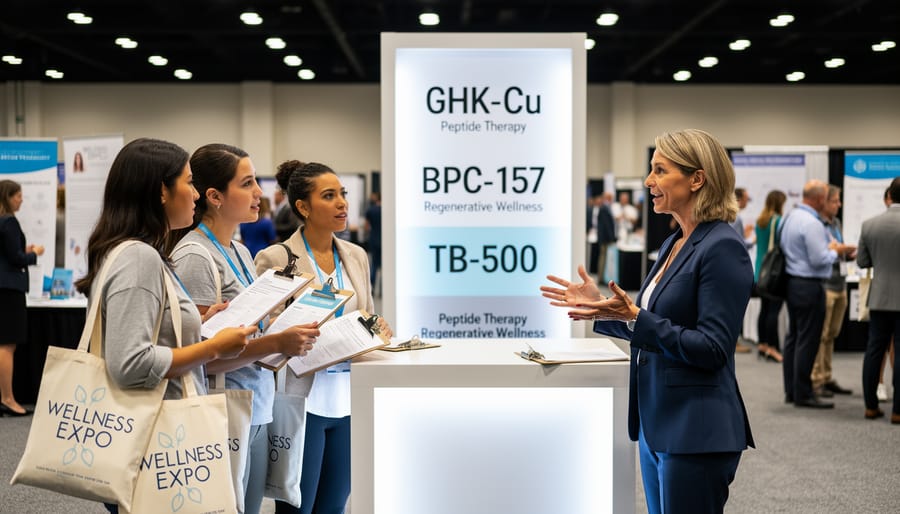
You’ll run into these names in a few different corners. In skincare and anti-aging chatter, GHK-Cu is the star, often because copper peptide serums have been around for years. Fitness recovery communities tend to bring up BPC-157 and TB-500, usually in forum threads about bouncing back from tough training. Wellness clinics and expo booths sometimes mention them too, and then there are online research-chemical marketplaces, where the products are typically labelled “for research use only.”
Here’s a local insider tip for Canadian readers: wellness and health expos are a great place to ask questions, but go in curious rather than convinced. Ask exhibitors what the product is, who makes it, and what claims they’re actually allowed to make. In Canada, products that aren’t approved by Health Canada generally can’t be promoted as treatments, so a vague or overly confident answer is worth noting. Jot down names and ingredients, then take the conversation to a licensed healthcare provider, like a doctor or pharmacist, before drawing any conclusions.
One more thing for athletes heading to races, tournaments or fitness festivals: sport anti-doping rules may restrict some of these substances. Check with your sport’s governing body or the Canadian Centre for Ethics in Sport before you compete.
Safety, Legality and Smart Questions to Ask

Curiosity is fine, but a few practical points matter before you go further. In Canada, GHK-Cu, BPC-157 and TB-500 are not approved by Health Canada as treatments, and many are sold “for research use only,” which means no regulator has checked their purity, dose or sterility. Quality can vary a lot between sellers, and a vial’s label doesn’t guarantee what’s inside.
The safest move is a conversation with a doctor or pharmacist, especially if you have a health condition or take other medications. Athletes should also check anti-doping rules, since some of these substances may be prohibited.
If a seller or clinic comes up at a wellness expo, treat it like any booth chat and know what to expect before you commit to anything. A few smart questions to ask:
– Is this product approved by Health Canada, and for what use?
– Is there third-party testing for purity and sterility?
– Who supervises its use, and what are the licensed credentials?
– What are the known risks and side effects?
– What happens if something goes wrong?
Vague or defensive answers are a good reason to walk away.
Common Questions About the GLOW Blend
Curious readers tend to land on the same handful of questions, so here are the quick answers, kept in plain language and backed by what’s actually known.
Is the GLOW Blend a medication?
No. “GLOW Blend” is a product label, not an approved drug, and Health Canada hasn’t authorized it as a treatment. Contents and ratios can vary from seller to seller.
Is GHK-Cu the same as a copper peptide face serum?
The molecule is the same, but the use is different. Cosmetic serums apply it to the skin, while the injectable research versions in blends are a separate matter with far less human evidence.
Is BPC-157 legal in Canada?
It isn’t approved as a drug here, and it’s generally sold as a “research chemical.” Rules around sale and use are strict, so a pharmacist or healthcare provider is the right person to ask.
Are TB-500 and thymosin beta-4 the same thing?
Not quite. Thymosin beta-4 is a naturally occurring protein, while TB-500 is a synthetic version of a fragment of it, so the two shouldn’t be treated as interchangeable.
Can athletes use these?
Often not. Sport anti-doping programs may prohibit some of these substances, so check the current prohibited list or ask your sport’s governing body before an event.
Where can I learn more safely?
Start with a doctor, pharmacist, or Health Canada’s own resources. At wellness expos, treat booth claims as a starting point for questions rather than as medical advice.
If you’re heading to a health expo or fitness festival, jot these questions down on your phone first. Exhibitors who know their stuff will happily answer them, and those who dodge are worth a second look.
So there you have it. GHK-Cu is the copper peptide tied to skin and collagen talk, BPC-157 is the “body protection” compound mostly studied in animals, and TB-500 is the thymosin beta-4 fragment researchers look at for tissue repair. The GLOW Blend simply bundles them under one label, and the evidence for the combination is still thin.
That’s why a cautious, curious approach works best. Treat bold claims with a raised eyebrow, check what Health Canada actually says, and bring your questions to a doctor or pharmacist. Wellness expos and clinics are great places to ask, so go in with a short list and don’t be shy.
Ready to find one near you? Browse the event categories on Events Finder Canada, try the search functionality to narrow by city, and pick up a few local tips if your first search comes up empty. Happy exploring!